Battery-Free Smart Locks for Data Centers: 5 Myths About Colocation Cage Security
Battery-free Passive Locks for colocation cages: no lock batteries, AES-128 encryption and offline audit records via the Electronic Key. Five myths, debunked.
- #Data Center
- #Colocation
- #Cage Security
- #Battery-free Smart Lock
- #Passive Lock
- #Electronic Key

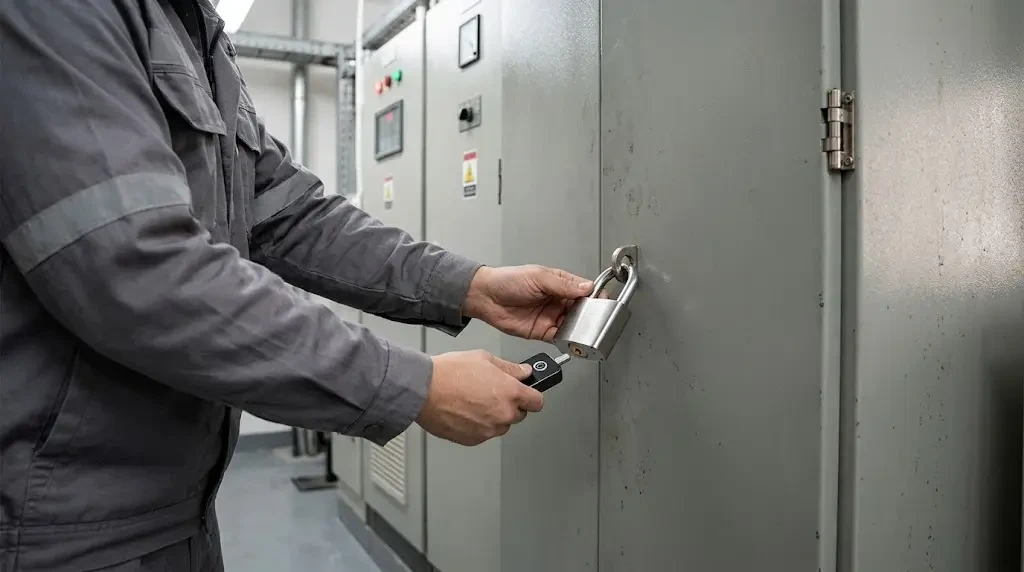
Ask a colocation operations lead what keeps them up at night and "cage access" comes up fast. Auditors now compare rosters, credentials and entry records line by line, and cabinet key custody is a standard audit check. Battery-free smart locks for data centers, specifically Passive Locks opened with an Electronic Key, are often dismissed on outdated assumptions. Here is how they actually compare with battery-powered smart locks.
Myth 1: "No battery in the lock means weaker security"
Fact: Authentication still happens inside the lock. A Passive Lock has no battery or capacitor; the Electronic Key powers it at the moment of contact, and the two authenticate with AES-128 or stronger encryption. The cryptography doesn't depend on a coin cell sitting in the cage door.
Myth 2: "Without power, there's no audit trail"
Fact: The Electronic Key stores at least 1,000 operation records offline and syncs them later. That matters when PCI DSS Requirement 9 expects physical access data to be kept for at least three months, and ISO/IEC 27001 control 7.2 expects reviewable entry records.
Myth 3: "Battery swaps are a trivial maintenance task"
Fact: In a hall with hundreds of cages, every swap is a scheduled, escorted procedure inside a customer's space. Uptime Institute's 2025 analysis found that 85% of human-error outages trace to procedures that were skipped or flawed. Removing a recurring procedure removes a failure point. A Passive Lock body also has no cell to leak or die.
Myth 4: "Drawing power from a key makes unlocking slow"
Fact: Energy harvesting, authentication and unlocking are typically completed within 3 seconds, which is quick enough for a technician answering a remote-hands ticket.
Myth 5: "Battery-free means maintenance-free"
Fact: Not quite. The lock body needs no battery, but the Electronic Key is a rechargeable device. Plan for key custody and charging. Each key handles at least 1,000 Passive Lock operations per full charge and can be paired with 65,000+ locks. Passive Locks are rated for at least 10,000 unlocking cycles.
The Bottom Line
For colocation cages, Passive Locks shift the maintenance burden from hundreds of lock batteries to a small fleet of managed Electronic Keys. Map your cage count, ticket volume and audit requirements before you pilot one row.